
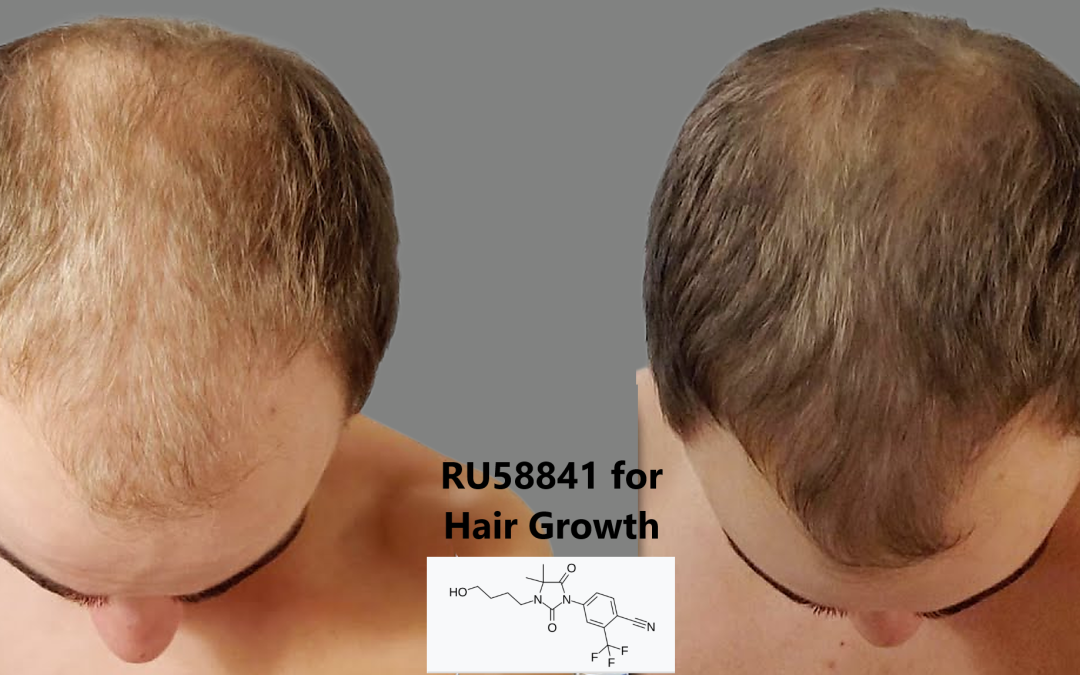
RU58841 for hair growth is an old story that keeps popping up on TikTok and Instagram. Before we get too excited, let’s hear the truth – the research fizzled out years ago and there is no current public clinical trial pipeline.
Now, let’s get into the detail of RU58841 for hair growth!
RU58841 is a lab-made anti-androgen. It blocks androgen receptors in the hair follicle. In theory, that stops DHT from shrinking hairs. It showed promise in animal and lab models. It never became an approved medicine. There are no large, published human clinical trials. If you use it, you’re experimenting. Proceed with caution. Wikipedia
What is RU58841?
RU58841 (also called PSK-3841 or HMR-3841) is a nonsteroidal anti-androgen. It was originally developed by Roussel Uclaf. It was explored as a topical drug for androgen-driven skin conditions. Think acne, pattern hair loss, and unwanted hair growth. It never made it through the full clinical path to approval. Wikipedia
Chemically, it binds to androgen receptors. That’s the lock on the follicle cell. DHT is the key. RU58841 sits in the lock first, so DHT can’t get in. That’s the basic idea. PubChem
How does RU58841 work?
Mechanism. RU58841 is an androgen receptor antagonist. It blocks the receptor on hair follicle cells. With the receptor blocked, DHT can’t trigger the miniaturization process that shrinks follicles over time. The goal is to hold or reverse that miniaturization. Wikipedia
Why it’s interesting. Finasteride lowers DHT levels system-wide. RU58841 tries to block the signal right on the scalp. That’s a different strategy. In theory, it could mean fewer systemic effects. In practice, we don’t have strong human data to prove that. Wikipedia
Formulation concept. Developers looked at it as a topical. Solutions discussed in papers or summaries often mention low single-digit percentages applied to the scalp. Keep in mind these are research contexts, not approved dosing instructions. PubMed
What does the research say?
Most of the evidence is preclinical. That means animal studies or human tissues studied in animals.
Hamster studies. Early work tested RU58841 on the hamster flank organ. That organ shrinks when androgens are blocked. Topical RU58841 drove a dose-dependent regression of the organ. Systemic anti-androgen effects were minimal in these tests, suggesting local action. This is a model for anti-androgen activity, not hair regrowth per se, but it showed the drug does what it’s supposed to do. PubMed
Human scalp on mice (xenograft) model. Researchers transplanted balding human scalp grafts onto nude mice. They conditioned some mice with testosterone to mimic androgen exposure. RU58841 treatment in this setup improved hair production from the balding grafts. Again, this is a lab model, not an in-person clinical trial, but it’s closer to human biology than a rodent flank organ. PubMed
Stump-tailed macaques. Stump-tailed macaques naturally develop a pattern similar to human male pattern baldness. Topical RU58841 increased hair density, thickness, and length in this model. That is a positive sign, and it’s one reason the compound drew attention. But it’s still an animal model. Translation to human results is not guaranteed. PubMed
Cell and receptor studies. Separate lab work in prostate cell lines and receptor assays confirms RU58841’s anti-androgen activity at the receptor level. This supports the mechanism but doesn’t tell us much about real-world hair outcomes or safety. PubMed
Bottom line on evidence. We have signs of efficacy in animals and lab models. We do not have robust, peer-reviewed, randomized human trials in androgenetic alopecia that made it to publication and led to approval. That’s the true gap. Wikipedia
Is RU58841 approved?
No. RU58841 is not approved by major regulators, including the FDA. It is generally sold as a “research chemical.” That status matters. It means there are no approved labeling, no official quality standards for consumer products, and no regulator-vetted safety data for long-term use in people. Wikipedia
For context: the FDA has been explicitly warning about unapproved or compounded hair-loss products in other categories too (for example, topical finasteride). The agency’s stance is clear: if a hair-loss product isn’t approved, the FDA hasn’t evaluated it for safety, effectiveness, or quality, and problems can occur. RU58841 sits outside the approval system entirely. U.S. Food and Drug Administration
How are people using it?
Let’s be very clear. This is not a recommendation to use RU58841. What follows is an explanation of what’s discussed in research contexts.
Topical approach. The compound has been explored as a topical solution applied to thinning areas. Research models and secondary sources mention low percentage solutions, often once daily applications. These are not medical instructions. There isn’t an approved package insert to tell you the right concentration, vehicle, or frequency. PubMed
Vehicles and mixing. You’ll see a lot of online chatter about solvents and carriers. That’s part of the problem. Without an approved product, there’s no standardized formulation, no manufacturing oversight, and no formal stability data for what you’re buying or mixing. Quality can vary a lot. That adds risk. (This variability concern mirrors the FDA’s broader warnings about unapproved topicals in the hair-loss space.) U.S. Food and Drug Administration
How does it compare to finasteride or minoxidil?
Different targets. RU58841 blocks the receptor on the follicle. Finasteride reduces DHT production by inhibiting 5-alpha-reductase. Minoxidil doesn’t touch androgens at all; it’s a vasodilator and growth promoter with its own pathways.
Evidence strength. Finasteride (oral) and minoxidil (topical) are FDA-approved for pattern hair loss in men (and minoxidil for women). They have multiple human trials behind them. RU58841 does not. That doesn’t mean RU58841 can’t work; it means we don’t have the same level of proof. And because RU58841 products aren’t approved, we also don’t have consistent quality or dosing standards. U.S. Food and Drug Administration
Combination ideas. Some people like the idea of combining a growth promoter (minoxidil) with an anti-androgen mechanism (finasteride or RU58841). That’s a logical stack on paper. But if you choose RU58841, you’re combining an approved drug with an unapproved research chemical. That raises both legal and safety questions. Talk to a clinician before you try any stack. U.S. Food and Drug Administration
Safety and side effects: what do we know?
What the models suggest. In macaques, researchers reported scalp benefits without clear systemic anti-androgenic effects at the doses used. That’s encouraging but limited. Animal data can’t guarantee human safety. PubMed
What we lack. We don’t have long-term, placebo-controlled human trials that map out side effects, systemic absorption, hormone changes, sexual side effects, mood effects, fertility issues, or rare risks. Without those trials, we’re guessing. And because supply is unregulated, even basic purity can’t be assumed. Wikipedia
Lessons from other unapproved topicals. The FDA has warned about side effects from compounded, unapproved topical finasteride, including systemic effects. That doesn’t mean RU58841 does the same thing. It does show that “topical” doesn’t equal “risk-free.” Skin can absorb drugs. Absorbed drugs can act beyond the scalp. U.S. Food and Drug Administration
Practical risks if someone experiments anyway. Irritation is common with many topicals. Contact dermatitis can happen. Poor compounding or contamination can add problems. Inconsistent dosing can cause swings in exposure. No pharmacovigilance system exists for research chemicals, so side effects may go untracked. These are real-world issues, not just theoretical ones. U.S. Food and Drug Administration
Medical advice. If you’re considering RU58841, speak with a dermatologist first. If you have a history of hormone-sensitive conditions, take extra care. If you develop side effects, stop and seek medical guidance. That’s the safest approach with any experimental product. (This is general health guidance; it’s not a substitute for seeing a clinician.)
Dosing and “how to use” questions
A lot of online posts mention figures like “1 percent” or “5 percent” solutions and daily applications. Those numbers come from lab models or secondary writeups that reference them. They are not clinically validated instructions for humans. There’s no approved label for RU58841. That means no official dose, no official schedule, and no official contraindications or drug-drug interaction guidance you can rely on. If you see a bottle with dosing directions, those directions have not been reviewed or approved by a regulator. PubMed
Who might consider RU58841?
This is not a recommendation, but let’s be honest about why people look at it.
- People who can’t tolerate finasteride but still want anti-androgen action at the scalp level.
- People who want to stack minoxidil with a local anti-androgen.
- People who’ve read the macaque and xenograft studies and want to try a receptor blocker instead of a hormone-lowering drug.
If that sounds like you, pause. Ask yourself what your risk tolerance is. Consider trying the approved options first. Consider seeing a hair specialist who can evaluate your pattern, your goals, and your medical background. That’s usually a safer starting point. U.S. Food and Drug Administration
Legal and sourcing issues
Since RU58841 isn’t approved, anything you see sold “for research only” is outside the normal drug system. Labels may say “not for human use.” Some sites sell it anyway. Quality control can be questionable. Potency can vary. Impurities can happen. If a seller claims it’s FDA-approved, that claim is false. Wikipedia
Regulators have been stepping up warnings across several drug categories that leak into consumer markets through gray channels. The message is consistent: if the product isn’t approved, the agency hasn’t checked it for safety, effectiveness, or quality. U.S. Food and Drug Administration
When will RU58841 be available commercially?
We don’t know. Development stalled years ago. It’s not moving through a public clinical pipeline today. Without a sponsor funding trials, filing with regulators, and building manufacturing, it won’t appear as a pharmacy-dispensed medicine. The realistic answer is simple: there’s no timeline. Wikipedia
Practical guidance if you’re researching options
- Start with approved therapies. Oral finasteride (men) and topical minoxidil have the strongest evidence base and the clearest safety labeling. Women have minoxidil as a first-line option. Discuss off-label options with a clinician if needed. U.S. Food and Drug Administration
- Add lifestyle and scalp basics. Manage inflammation. Treat dandruff or seborrheic dermatitis if present. Optimize iron, vitamin D, thyroid, and other medical factors with your doctor. These aren’t cures, but they help your baseline.
- If you’re still curious about RU58841. Learn the evidence and the gaps. Understand you’re entering “research chemical” territory. Be skeptical of claims and before-and-after photos without controls. If you proceed, do it under medical supervision, track your scalp and your general health, and stop if you notice adverse effects. Wikipedia
Conclusion
RU58841 is a compelling idea. A local receptor blocker that stops DHT at the follicle is elegant. Animal and xenograft models back it up. The macaque data are especially interesting. But the clinical story never got finished. There’s no approved product, no standardized formulation, and no large human trials in the public record to define benefits and risks over years.
If you’re fighting pattern hair loss, you already have options with proven track records, like finasteride (men) and minoxidil. RU58841 may feel like a missing piece, but right now it stays in the “experimental” bucket. If you value safety, consistency, and predictability, stick with regulated paths or enroll in proper clinical research when available. If you still want to explore RU58841, do it with eyes open, talk to a clinician, and treat it like what it is: a research chemical with promise on paper and unknowns in practice. PubMed
References
- RU-58841 overview and development history. Wikipedia. Wikipedia
- PubChem entry for RU-58841, including identifiers and chemical classification. PubChem
- Battmann T et al. “RU 58841, a new specific topical antiandrogen.” Early hamster model work outlining topical anti-androgen activity. PubMed
- De Brouwer B et al. “A controlled study of the effects of RU58841… on human hair production by balding scalp grafts maintained on testosterone-conditioned nude mice.” Xenograft model evidence. PubMed
- Pan H-J et al. “Evaluation of RU58841 as an anti-androgen in prostate PC3 cells and as a topical anti-alopecia agent in the bald scalp of stump-tailed macaques.” Highlights macaque model outcomes. PubMed
- FDA alert on unapproved compounded topical finasteride. While not about RU58841 specifically, it illustrates the agency’s stance on unapproved hair-loss topicals and systemic risk with topicals. U.S. Food and Drug Administration
Medical Disclaimer
This content is educational, and not medical advice. Always consult a licensed clinician before starting, changing, or stopping any drug, supplement, or health regimen, especially if you have medical conditions or prescriptions.
Even at recommended doses, side effects can occur, and risks remain. By using this content, you agree we are not liable for any outcomes.
Reading this does not create a doctor-patient relationship. The authors and publishers disclaim all liability; you are solely responsible for how you use this information and any supplements.
Struggling with hair loss or thinning?
Get results with our 90-Day Hair Restoration Regimen—backed by science and proven methods. This e-book gives you a step-by-step plan to restore thicker, healthier hair naturally. Ready for real change?
Download now at Otter Hair Labs and start your journey to regrowth today.
