
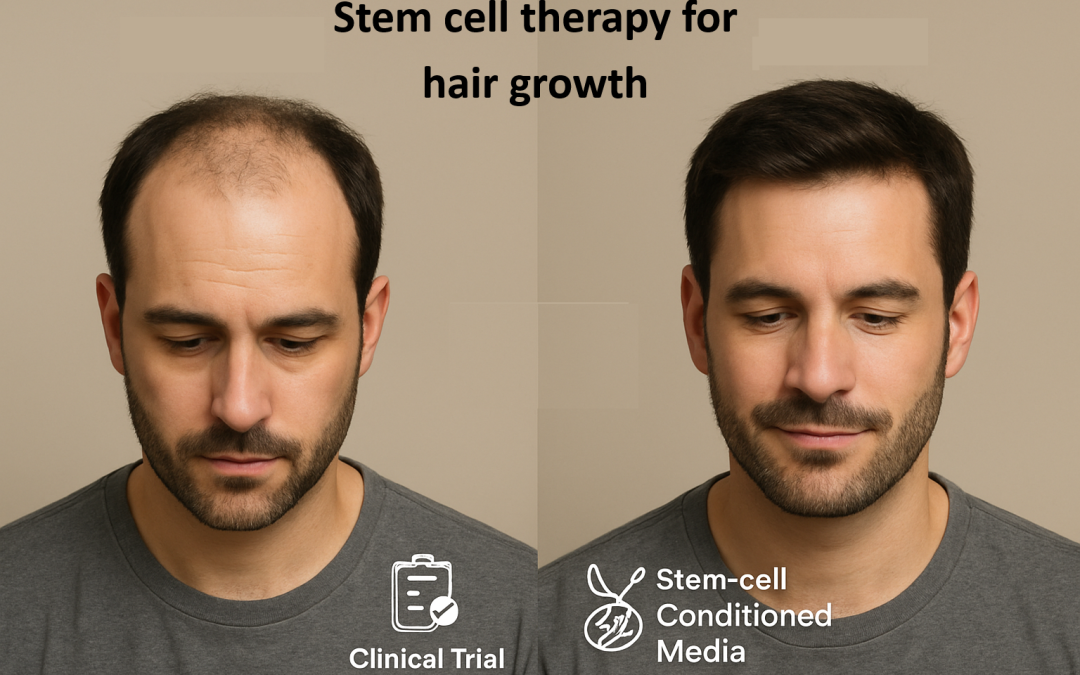
Stem cell therapy for hair growth? What is happening?
A new cure every day?
Hair loss hurts. It chips away at confidence. It makes styling harder. It can change how you feel in photos.
So, a big question keeps popping up. Can stem cells bring hair back?
Short answer – Maybe.
But let’s go step by step, and we will keep it simple.
What is a stem cell?
A stem cell is a special cell; it can self-renew. It can also turn into other cell types.
Think of it like a blank template. Under the right signals, it can become skin, muscle, or hair-related cells.
There are different types of stem cell:
- Embryonic stem cells can become almost anything.
- Adult stem cells are more limited, yet still useful.
You also hear about induced pluripotent stem cells, or iPSCs.
Scientists reprogram normal cells into a stem-like state. These iPSCs can then be guided to form hair structures in the lab. PubMed
Hair follicles also contain their own niche cells. Two big players are dermal papilla cells and hair follicle stem cells. They control growth phases. They talk to each other through signals and the surrounding matrix.
Understanding this cross-talk is the core of modern hair regeneration. ScienceDirect
Stem cells for hair growth (what that really means)
People say “stem cell therapy” in many ways. It can mean several approaches:
- Cell-based therapy.
You expand key hair cells in a lab.
For example, dermal papilla or dermal sheath cells.
Then you inject or implant them back into the scalp.
Goal: reboot miniaturized follicles or build new ones. PMC - iPSC-derived follicles.
You start from induced pluripotent stem cells.
You engineer tiny hair structures.
You try to grow complete, hair-bearing units.
Labs have grown skin organoids with hair in dishes and in mice.
This looks like “hair cloning,” but it is not yet a clinic service. PubMed - Secretome or conditioned media.
Instead of whole cells, you use what cells release.
This includes growth factors, cytokines, and exosomes.
Adipose-derived stem cell conditioned medium (ADSC-CM) is popular.
Some studies report thicker hair and more density.
But results vary, and protocols differ. Stem Cells Journal - Follicle banking.
You harvest some of your follicles now.
You cryopreserve them for the future.
The idea: when cell therapies mature, your stored follicles can supply cells.
This is available in select centers as a banking service, not a treatment. Hairclone

Where is the research today?
Let’s break it into buckets.
A) Conditioned media and secretome studies
Human trials exist for ADSC-derived products. A 2020 randomized trial found that adipose-derived stem cell constituent extract helped regrow hair versus vehicle in androgenetic alopecia. Hair counts improved.
Tolerability was good. Stem Cells Journal
More recent work tested ADSC-CM with minoxidil in men. Design was randomized and double-blind. Both sides improved over time. The between-side difference, however, was not always strong.
This suggests benefit is possible, but not a magic bullet. PubMed
A 2024 meta-analysis also reviewed stem-cell-derived conditioned media for alopecia.
It reported encouraging signals overall, yet stressed heterogeneity across studies.
We need bigger, better controlled trials. JPRAS
B) Building or rejuvenating follicles with cells
Scientists are trying to rebuild hair units with the right mix of cells. Skin organoids can form hair follicles in vitro. In some cases, they integrate when transplanted in animal models.
This is a huge scientific leap. But translating that safely to patients takes time. PubMed
One company working in this space is Stemson Therapeutics. Updates in 2024 described creation of human hair follicles in humanized mice using engineered follicular units.
The plan is to move toward human trials, but it is not yet a clinic treatment. Follicle Thought
C) Preclinical headlines and early signals
Media stories can be exciting. In 2025, coverage highlighted preclinical work where a stem-cell-linked therapy spurred strong regrowth in mice. This is cool science.
But it is still preclinical. Mouse success does not equal human approval. Fox News
Other outlets have echoed similar “rapid regrowth” claims.
These came from animal work or very early research.
Great to watch, but we must stay realistic. FOX 4 News
D) Reviews on regenerative hair medicine
Recent reviews outline the landscape. They list adult stem cells, mesenchymal stromal cells, and follicular cells as candidates. They forecast potential for anagen prolongation, thicker fibers, and follicle regeneration. They also call out the gaps: standardization, dosing, and long-term safety. PMC
When will stem-cell treatments be commercially available?
Here is the honest status today – there is no FDA-approved stem cell or exosome therapy for common hair loss yet. Any clinic in the United States offering “stem cells” or “exosomes” for hair is operating outside FDA approval.
The agency has issued multiple warnings about unapproved products. Some patients have been harmed by unsafe interventions in other settings. U.S. Food and Drug Administration
So, what about timelines?
Several groups are inching forward.
- Follicle banking is already offered by some UK clinics. This is banking, not treatment.
HairClone says it plans clinical work to optimize cell-based rejuvenation, with the aim of larger international trials later. Early procedural work was signposted for 2025, but broad treatment access depends on results and regulators. Hairclone - iPSC-based follicle generation is progressing in labs. Stemson has public updates and presentations, and watchers expect first human studies to start before broad rollout.
Even if trials begin, routine availability will still take years. Safety, manufacturing, consistency, and cost need to be nailed. Follicle Thought - Conditioned media products (from adipose or other cells) show signals in trials and meta-analyses. Some over-the-counter products market “peptides,” “exosomes,” or “secretomes.” Regulatory status varies by country and by product. If it claims to be a live cell or exosome therapy, be cautious. In the US, none are FDA-approved for hair. Stem Cells Journal
Bottom line on availability – you can bank follicles in some places. You can also enroll in trials if eligible. You cannot buy a fully approved, standardized stem-cell hair therapy at your local clinic yet. That is still in the future.
Safety: what you need to know now
Safety comes first. Regulators warn the public about unapproved stem cell and exosome products. The FDA has consumer alerts on clinics marketing such biologics. There have been serious adverse events linked to unapproved uses. This is not fear-mongering.
It is documented. U.S. Food and Drug Administration
In the UK, watchdog reporting in 2025 flagged beauty clinics offering banned human-origin exosome treatments. Scientists pointed out infection and contamination risks.
This is why regulation exists. Biologics are not simple cosmetics. The Guardian
If you consider anything “stem-cell-like,” ask key questions:
- Is it part of a registered clinical trial?
- Is there an independent ethics review?
- Is the product FDA-approved (or MHRA-approved in the UK) for this use?
- What are the known side effects?
- How is the product manufactured and tested for safety?
- What is the real evidence in humans, not mice?
If a clinic cannot answer, walk away. Save your money. Protect your health.
Practical guide: what can you do today?
You probably want actionable steps.
Here is a simple plan.
- Use proven treatments first.
Minoxidil helps keep hair in the growth phase. Finasteride or dutasteride reduce DHT that miniaturizes follicles. These are approved, with known safety profiles when used correctly. If you cannot take oral meds, ask about topicals and low-dose options.
Consider low-level light therapy devices cleared by regulators. They can be combined with medications. Ask a dermatologist what makes sense for you. (Background context on AGA mechanisms and standard care in reviews.) MDPI - Evaluate “regenerative add-ons” carefully.
If you see ADSC-CM serums or similar, check the evidence and the labeling. Human trials exist, but results are mixed and protocols vary. Make sure you are not paying for an illegal, unapproved biologic. Stem Cells Journal - Consider follicle banking if you are a planner.
If you live near an approved banking program, you can preserve follicles now. The hope is to use them later when cell therapies mature. This is optional, and not without cost.
But it is one way to “future-proof.” Hairclone - Follow the real science, not just the headlines.
Preclinical breakthroughs in 2025 look exciting. They show what may be possible. But they are not the same as clinic delivery. Use news as a signal to watch, not a promise to buy. Fox News
Frequently asked questions
Is PRP a stem cell therapy?
No. PRP is platelet-rich plasma. It is not the same as stem cells. Some clinics combine PRP with other methods. But PRP by itself is not a stem cell treatment.
Are exosomes approved for hair growth?
No, not in the US. FDA has warned the public about unapproved exosome products. Be very cautious with any exosome offer at a med spa. U.S. Food and Drug Administration
What about microneedling plus “stem cell serum”?
It depends on what the serum is. If it is a cosmetic with peptides, that is not stem cell therapy.
If it claims to contain human exosomes or live cells, check legality and safety. Evidence so far is early and mixed for secretome-type add-ons. JPRAS
Will hair cloning be a thing?
That is the goal for some programs. Lab-grown follicles in animals are real. Human trials are the next step. Widespread access will likely take years, not months. Follicle Thought
Stem cell science for hair is moving fast. We now know much more about how follicles form and cycle. We can grow hair-bearing skin organoids in the lab. We can nudge miniaturized follicles with cell signals. We can bank follicles for future use. PubMed
But today’s reality is clear. There is no FDA-approved stem cell or exosome therapy for common pattern hair loss. Some human studies with conditioned media show promise. Others are mixed.
The gold standard will be large randomized trials with long follow-up. Safety must be proven, not assumed. Stem Cells Journal
If you want to act now, use proven treatments. Work with a dermatologist. Consider clinical trials or banking only if you understand the risks, the costs, and the uncertainty. Keep your expectations grounded. Watch for true regulatory milestones. When a safe, consistent, approved cell therapy arrives, you will know. It will not be a whisper. It will be big news with data behind it.
References
- Fox News coverage of preclinical stem cell therapy results in mice (June 25, 2025). Useful as news context, not medical guidance. Fox News
- Follow-up coverage on experimental serum and rapid regrowth headlines (November 2025). Also preclinical context. Fox News
- Stemson Therapeutics updates on engineered human follicles in humanized mice and development path. Follicle Thought
- HairClone follicle banking and planned clinical work in the UK. Hairclone
- Randomized double-blind clinical trial of adipose-derived stem cell constituent extract for androgenetic alopecia (2020). Stem Cells Journal
- Randomized double-blind trial testing ADSC-conditioned media with minoxidil in men (2023). PubMed
- Meta-analysis on stem-cell-derived conditioned media for alopecia (2024). JPRAS
- Review: Advanced medical treatments for hair loss, including roles for dermal papilla and follicle stem cells (2025). PMC
- Basic science on hair organoids and development mechanics. PubMed
- FDA consumer alerts regarding unapproved stem cell and exosome products; public safety communications on harms. U.S. Food and Drug Administration
- Pew Charitable Trusts brief summarizing harms from unapproved stem cell interventions. Pew Charitable Trusts
- UK reporting on banned human-origin exosome treatments in beauty clinics (2025). The Guardian
Bonus: Simple glossary
- ADSC-CM: Adipose-derived stem cell conditioned medium.
Liquid rich in growth factors released by fat-derived stem cells. - Dermal papilla (DP) cells: Specialized cells at the base of the follicle that regulate growth.
- iPSC: Induced pluripotent stem cell.
A reprogrammed adult cell with stem-like potential. - Organoid: Mini-organ grown in the lab from cells.
- Exosomes: Tiny vesicles released by cells that carry signals.
- Follicle banking: Storing your follicles for future cell-based therapies.
Conclusion
Stem cells could reshape hair restoration. They might add to, or one day surpass, today’s options. But right now, they are not a plug-and-play cure. Stay curious. Stay safe.
Follow the data, not the hype.
Medical Disclaimer
This content is educational, and not medical advice. Always consult a licensed clinician before starting, changing, or stopping any drug, supplement, or health regimen, especially if you have medical conditions or prescriptions.
Even at recommended doses, side effects can occur, and risks remain. By using this content, you agree we are not liable for any outcomes.
Reading this does not create a doctor-patient relationship. The authors and publishers disclaim all liability; you are solely responsible for how you use this information and any supplements.
Struggling with hair loss or thinning?
Get results with our 90-Day Hair Restoration Regimen—backed by science and proven methods. This e-book gives you a step-by-step plan to restore thicker, healthier hair naturally. Ready for real change?
Download now at Otter Hair Labs and start your journey to regrowth today.
